
Clarence Warrant Checks
Clarence publishes no public warrant list, municipal-court lookup, or online recall form. Pair the state court index with a direct call to confirm any active warrant.
- Collect the full name, date of birth, citation number, case ID, and any missed-court notice.
- Search Iowa Courts Online through the most precise available field.
- Confirm that the result is a Cedar County case and note the latest public docket entry.
- Call the Cedar County Clerk of Court at 563-886-2101 to ask about the issuing court and public status.
- Call Clarence Police at 563-452-3625 or Cedar County dispatch and Sheriff at 563-886-2121 for local service or surrender routing.
A blank result does not mean no warrant exists. Clarence citations can take 10 to 14 days to post online, and sealed material never appears there. Call 911 only for a true emergency.
Clarence Warrant Contacts Share City Hall
Clarence Police shares City Hall, at 411 Lombard Street, P.O. Box 418, Clarence, Iowa 52216. One number, 563-452-3625, covers city and police contact. Sharing a building makes the department easy to find. It does not give City Hall staff any judicial authority over warrants.
Clarence Police Department
Police handle local law enforcement and can route a city contact. They may serve a valid order but cannot recall it.
Cedar County court offices
The Clerk maintains the case docket, and an Iowa magistrate or judge issues and changes a judicial warrant.
The official Clarence Police page is shown below as the city contact source.
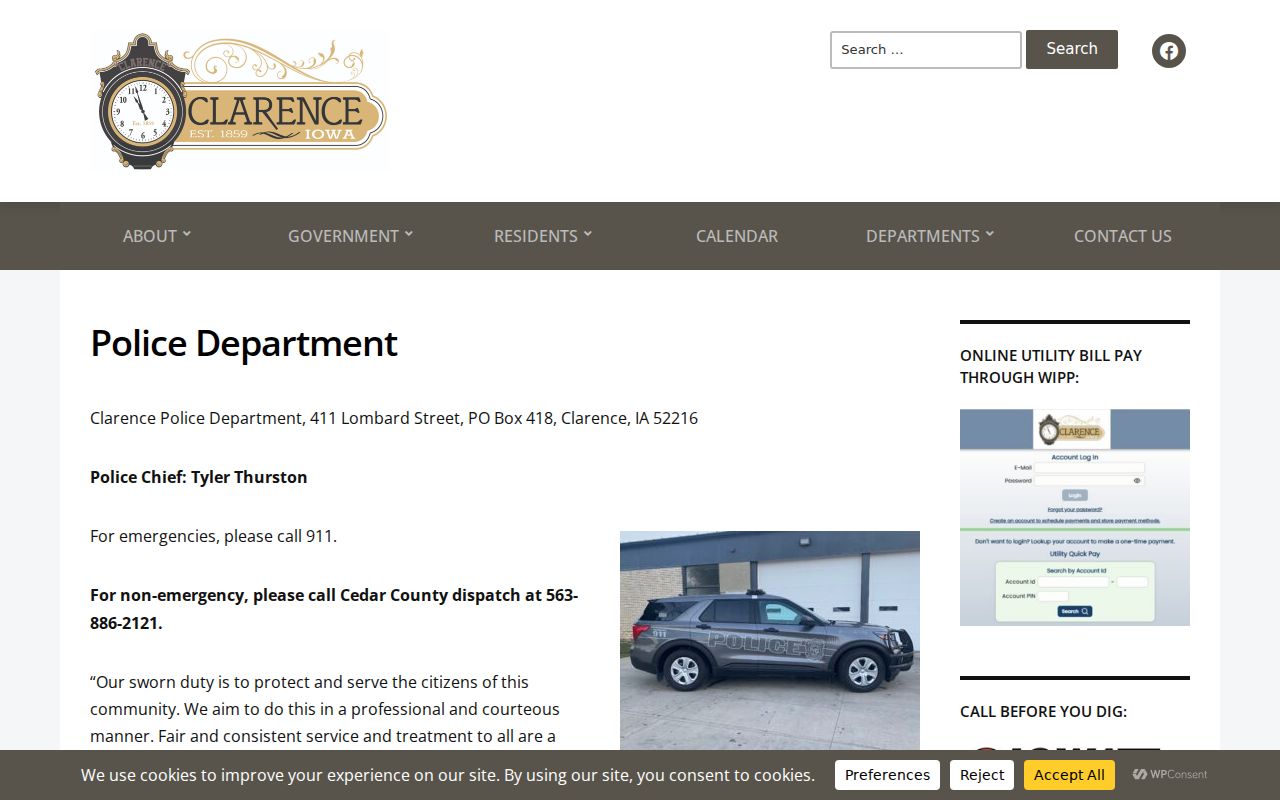
What the city posts is the police contact route, not a person-level warrant lookup. It offers no public warrant database for Clarence.
Policing and Courts in Clarence
Clarence has its own city police department, and non-emergency calls route through Cedar County dispatch. Court authority for Clarence sits in the Iowa District Court for Cedar County. Magistrates there hear initial appearances, simple misdemeanors, scheduled violations, traffic matters, and other assigned cases. District associate judges handle assigned criminal and municipal-infraction matters. Clarence runs no separate municipal court. Iowa Code §364.22 sends an original municipal-infraction citation to the district-court clerk and allows trial before a magistrate, a district associate judge, or a district judge. No City Hall counter can reset a court date. It also cannot recall a district-court warrant. That split makes the right call easy. For a Clarence policing question, call the city police; for non-emergency officer routing, county dispatch; for the case record, the Clerk; for service or custody procedure, the Sheriff.
Clarence Warrant Calls Route Countywide
Clarence routes non-emergency police calls to the Cedar County Law Enforcement Center at 563-886-2121. That number is an operational detail. It does not guarantee any call reaches a dedicated warrant officer. The county publishes no warrant unit or status script.
| Contact | Purpose |
|---|---|
| 563-452-3625 | Clarence city and police contact |
| 563-886-2121 | County non-emergency dispatch, Sheriff, service, or custody routing |
| 563-886-2101 | Cedar County Clerk docket and issuing-court questions |
| 911 | Emergency assistance only |
Ask the clerk if a warrant is still active. Ask law enforcement how to respond safely. Neither office in Clarence should do the other's job, and no phone call changes the court record.
Warrants in Clarence: The Main Types
Warrant matters tied to Clarence follow Iowa terminology and the county district-court structure. The type of order points to the right next step.
| Type | How it may arise | Authority |
|---|---|---|
| Arrest warrant | A complaint or affidavits establish probable cause | Iowa magistrate or judge |
| FTA arrest warrant | Willful failure to appear on a citation under §805.5 | Judicial officer in the case |
| Bench warrant | A missed setting or failure to obey a court direction | The issuing court |
| Municipal infraction | A civil Clarence code citation filed with the district clerk | Magistrate, associate judge, or district judge |
A municipal infraction is not a criminal warrant. No separate Clarence city court hears them. Iowa sources use arrest warrant, failure-to-appear arrest warrant, and bench warrant rather than capias pro fine.
Clarence Warrant Visit Hours at City Hall
Clarence City Hall keeps weekday hours of 8:00 a.m. to noon and 1:00 to 5:00 p.m. The midday closure matters when planning a visit. Those hours are not a warrant-counter schedule. They also do not promise an officer or court official will be free. The official Clarence city page shows the City Hall setting and posted hours.

Access is not continuous through the day. Court records for Clarence stay with the Cedar County Clerk at the courthouse in Tipton. Non-emergency police routing stays with county dispatch.
Before traveling: Call the proper office, give the case ID if known, and ask whether an in-person visit is needed.
Clarence Warrant Records: What They Show
Clarence publishes no warrant-number format, status codes, or city warrant form, so work from the official Iowa court case. Confirm any unclear event with the Clerk.
| Case ID | The district-court identifier, represented as Cedar County case ID, used to distinguish the file. |
|---|---|
| Person identifiers | Name and available birth details used to reduce mistaken matches. |
| Charge or event | The alleged offense, citation, or missed appearance linked to the matter. |
| Issuing authority | The magistrate or judge with power over the order. |
| Bond or conditions | Any public endorsed amount or release requirement, subject to judicial review. |
| Return or status | A docket event that still requires current confirmation. |
Iowa Code §804.2 spells out what an arrest warrant must show. It must identify the defendant if known. It must also state the offense, the issuing date and county or city, and carry the magistrate's signature, while public access in Clarence can depend on service and case stage.
A Clarence Missed-Date Response
Spotted a missed court date in Clarence? Keep the citation or notice close. Search Iowa Courts Online by citation number, case ID, or an exact name and date of birth. Confirm the case sits in Cedar County. Then call the Clerk for the public docket. Ask what court action is required. If a warrant may be active, ask the Sheriff about current surrender or service procedure before heading to Clarence City Hall, the courthouse, or the Law Enforcement Center. Clarence publishes no walk-in surrender hours or bond-window instructions. When a direct question could bring an arrest, an attorney can contact the issuing court for you. After any required appearance, payment, motion, or bond, ask the Clerk whether the court entered a recall or a new order. In Clarence, a promise to appear, a police conversation, or a receipt does not by itself establish clearance.
Clarence Warrants and Cedar County
Clarence sits inside a single Cedar County court structure. City police and county dispatch handle the local pieces. The Iowa District Court creates and controls the judicial record itself. The Cedar County Sheriff serves warrants countywide and routes people into custody. Police agencies trade warrant data through the IOWA System, but that network stays closed to public self-service searches.
Warrant flow: Clarence Police and county dispatch › Iowa District Court for Cedar County › Cedar County Sheriff › IOWA System.
Start with the Cedar County warrant records overview for the full county process. It walks through each office and step. The county inmate roster is a different tool: it lists people currently held, sometimes with booking or bond fields, but it is not an outstanding-warrant list. A name absent from custody settles nothing about a Clarence warrant.
Four Clarence Roles in Plain Terms
Four public roles cover a Clarence warrant question. City police investigate, respond, and may serve valid orders. County dispatch sends and coordinates non-emergency law-enforcement resources. The Cedar County Clerk keeps the public district-court file, while the judicial officer decides whether a warrant issues, stays in force, or gets recalled.
- City police contact
- A local operational route, not a court-status guarantee.
- County dispatch
- A communications route for officers and the Sheriff, not a judicial clerk.
- District-court Clerk
- The custodian who identifies the public docket and issuing court.
- Judicial authority
- The magistrate or judge who can enter the order that changes a warrant.
Getting these roles right matters in Clarence. The myth that "police at City Hall" means a clerk can take payment and cancel a district-court order is just that, a myth.
Accessing Clarence Warrant Records
Iowa public-record rights do apply to Clarence matters. Even so, court confidentiality still shields unserved warrants, searches, juvenile files, sealed material, and protected data.
Key rules:
Iowa Code chapter 22 governs examination of public records, subject to lawful exceptions.
Iowa Code §804.29 protects arrest-warrant application information until arrest return or initial appearance.
Iowa Code §232.147 restricts juvenile court records.
Under §808.13, search-warrant applications and affidavits stay confidential until execution and return. That makes Iowa Courts Online a handy case index, not proof of current warrant status. Ask the Clerk what can lawfully be released.
Clarence Payment Calls and Clearance
Watch for payment scams. A caller may claim to represent Clarence Police or the court and demand money on the spot. In 2026 the Iowa Judicial Branch warned that courts never demand gift cards or bitcoin, never send warrant demands by unsolicited call or text, and never send officers to collect fines. Hang up. Then dial an official number yourself. Clarence publishes no warrant fee, online recall form, amnesty event, or municipal payment portal. For a genuine Cedar County court debt, pay only through the official court route after matching it to the case. A Cedar County voluntary payment plan can help with certain delinquent county court debt. It is not warrant amnesty, and it does nothing to change driver-license status on its own. One last step: confirm with the issuing court. Paying a fine, posting bond, or getting a new date does not clear a Clarence warrant until the court takes the required action. Keep the docket number and your receipt. Then ask law enforcement whether they need updated service information.