
How Municipal Court Warrants Work
Cedar County runs its city cases through one state court system. No separate municipal court or city warrant portal exists here. A city officer's citation, an ordinance problem, a traffic ticket, or a missed setting all end up in the Iowa District Court for Cedar County, Judicial District 7. Magistrates, district associate judges, and district judges all act within that single structure. Other states give each city its own court and its own warrant desk. Iowa does not. In Cedar County, the Clerk of Court holds the files. Criminal, traffic, scheduled-violation, civil, and municipal-infraction cases all sit in that office, which keeps the District Court docket. City police may begin the contact or serve court process. They never replace the clerk as keeper of the record. Local public terms are arrest warrant, failure-to-appear arrest warrant, and bench warrant. You will not see capias or capias pro fine in Iowa usage here.
Cedar County Municipal-Infraction Route
Iowa cities pursue ordinance violations through a civil route. Iowa Code section 364.22 spells out that municipal-infraction process. A municipal infraction is a city-ordinance offense, civil rather than criminal. The original citation gets filed with the district-court clerk. Trial may go to a magistrate, a district associate judge, or a district judge. The citation itself names the person charged, identifies the infraction, states the civil penalty, and gives the time and place for the court appearance. Miss a Cedar County civil setting and the statute allows judgment or contempt mechanisms instead. That is not automatically the criminal failure-to-appear arrest warrant. Iowa Code section 805.5 describes that separate warrant. The exact docket and order control. This distinction keeps a Cedar County city matter from being forced into an out-of-state municipal warrant model.
Municipal Courts Across Cedar County
Five Cedar County cities post official police contacts, and none publishes its own municipal court or public city warrant lookup. Officers can still issue citations and act on valid warrants under Iowa law. The District Court clerk holds the records. City police or county dispatch can point you to the local enforcement channel.
| City | Police contact | Court and warrant route |
|---|---|---|
| Tipton | Tipton Police, 563-886-2424 | Cedar County Clerk and District Court |
| Wilton | Wilton Police, 563-732-2311 | Cedar County Clerk and District Court |
| West Branch | Police message line, 319-643-2222 | Cedar County Clerk; county dispatch as appropriate |
| Durant | Durant Police, 563-785-6049 | Cedar County Clerk; county dispatch option |
| Clarence | Police and county dispatch routes | Cedar County Clerk and District Court |
A city contact helps with the citation or issuing agency. No city clerk can recall a District Court warrant in Cedar County.
Cedar County City Police Are Not Courts
A police department page may show an address, a phone, a mission statement, and dispatch instructions. It is not a warrant register. Tipton police and the Cedar County Clerk are different offices, even when both touch parts of a city-originated case. The officer enforces the law and may serve process. The clerk keeps the court record. That office also handles procedural routing. The judge or magistrate makes the judicial decision. The Cedar County Sheriff's Office plays a different part entirely, running countywide law enforcement, custody, service, and surrender routing. Its inmate roster shows current custody, not every city or county warrant. A name missing from a police page, the sheriff roster, or a public docket search does not prove that no warrant exists. Restricted or unserved material may not display. Note: city police pages identify agencies and contact routes; only the controlling court can confirm the legal effect of its warrant order.
Cedar County Municipal Warrant Checks
Cedar County has no city-by-city municipal warrant portal to search. Begin at the statewide trial-court index. Then use the clerk and sheriff to fill the gaps. Have the full name, date of birth, citation number, 17-character case ID, city, issuing agency, and missed date when known.
- Search Iowa Courts Online by case ID or citation number, then use name and exact date of birth if needed.
- Choose Cedar County and read the public docket for the citation, missed event, court order, next setting, and payment entry.
- Call the Cedar County Clerk of Court at 563-886-2101 to ask which judge or setting controls the matter and whether a warrant is active.
- Call the relevant city police agency for issuing-agency questions, or Cedar County dispatch and sheriff at 563-886-2121 for service and custody routing.
- Use the courthouse public terminal or a judicial-branch public-record request when the online index does not supply an open record.
Each channel answers a different question in Cedar County. A police record cannot replace a court order, and a docket may not show every restricted law-enforcement detail.
Cedar County Courthouse Record Hub
The Cedar County Clerk of Court works from the Cedar County Courthouse, 400 Cedar Street in Tipton. Call 563-886-2101. The email is countyclerk.cedar@iowacourts.gov. Ask for the docket status, plus the setting that issued an order and the steps the court accepts. Staff explain process, but they cannot advise you on a plea or any legal choice. The official Cedar County court directory lists the courthouse and clerk contact, and it confirms that city-originated cases run through Cedar County's District Court office rather than a municipal-court counter.
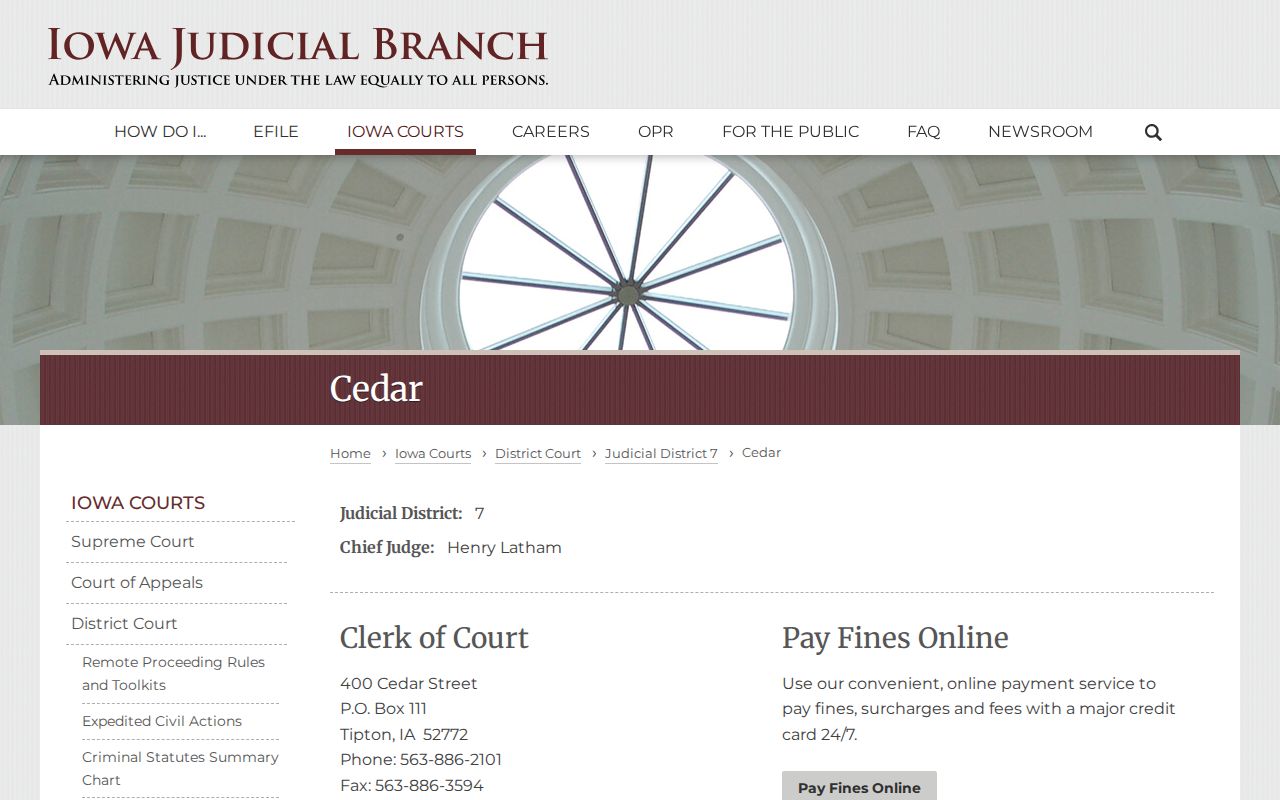
The courthouse page also lists security and scheduling details. Call before a visit if a warrant may be active. Cedar County publishes no warrant-only walk-in window. Every city case belongs at the District Court office.
Municipal Warrants: What They Show
Cedar County posts no single municipal warrant result, so the details sit in several places. Pull the city citation, the Iowa Courts Online docket, the court order, and any later service or release entries. Match the county and case number first. Then read each event and status date in context.
| Case or citation ID | The official identifier, such as DISTRICT COURT CASE ID; no Cedar city-warrant format was found. |
|---|---|
| City and agency | The city ordinance or officer that began the citation process. |
| Case type | Municipal infraction, traffic, scheduled violation, misdemeanor, or another filed matter. |
| Judicial setting | The magistrate, associate-judge, or district-judge part of the Iowa District Court. |
| Order or warrant event | The missed date, issue event, return, recall, quash, or other docket action if public. |
| Penalty or bond | A civil penalty, court debt, or court-set release condition, each with a different legal role. |
A balance on file does not prove an active warrant in Cedar County. Ask the clerk for the current procedural status instead.
Cedar County Public Record Requests
Iowa Code chapter 22 opens most public records unless another law seals them. Court files also answer to judicial-branch custody and access rules. Name the Cedar County case, citation, date range, and the docket or document you want. The custodian may charge for copying, review, or delivery where allowed. The Iowa Judicial Branch records-request page spells out who holds each record, which terminals are public, how to ask, what it costs, and what stays restricted.
Open-records requests reach only material a court has not sealed. Arrest-warrant applications and affidavits can stay confidential until arrest return or initial appearance under section 804.29. Juvenile records carry added restrictions of their own. In Cedar County, a custodian may withhold those parts even when other docket entries are public.
Cedar City Matters Versus FTA
A civil municipal infraction and a criminal failure to appear are different animals. Section 364.22 sends the municipal citation to District Court and offers civil judgment or contempt tools. Section 805.5 covers willful failure to appear as a citation directs, and it calls for an arrest warrant. The underlying filing and court order decide which path a Cedar County case takes. So read the papers, not the label.
| Matter | Initial process | Possible missed-date result |
|---|---|---|
| Municipal infraction | Civil city citation filed with district clerk | Judgment or contempt under the case order |
| Traffic or scheduled violation | Citation with payment or appearance terms | FTA arrest warrant when section 805.5 applies |
| Pending criminal case | Complaint or other charging document | Bench or arrest process under the court's authority |
Don't infer the warrant type just because a city officer wrote the first citation. The Cedar County court order tells you what it is.
Clearing a Municipal Court Warrant
Whatever the page label says, only the Iowa District Court for Cedar County can clear the warrant. The city offers no municipal payment portal, amnesty day, recall form, or posted surrender window. Confirm the exact case before you pay or appear.
- Ask the clerk whether the case has a warrant, civil judgment, contempt issue, required appearance, payment term, or bond.
- Ask whether counsel may arrange an appearance or file a motion to recall or quash. No Cedar-specific motion form or fee was located.
- Call the sheriff before any surrender. Do not assume a walk-in will produce immediate release.
- Use official court payment only if the clerk confirms it fits the case. Payment may not replace an appearance.
- After the judge acts, confirm the new docket status and ask the sheriff whether the enforcement record was updated.
Warning: A city payment or police conversation does not recall a District Court warrant; obtain confirmation from the clerk and sheriff.
When bond applies in Cedar County, the court's order controls; the Iowa uniform bond page lays out the limited statewide schedule.
That schedule is not a universal Cedar County price list. A judicial officer may set or review the actual terms.